Semiconductor equipment components
Equipment O-rings, flat gaskets and custom profiles selected for the operating environment.

JINGUI / FUMED-SILICA-REINFORCED SILICONE
Fumed-silica-reinforced solid and liquid silicone rubber. Compare QX and LSR grades, physical properties and processing parameters.
Discuss your application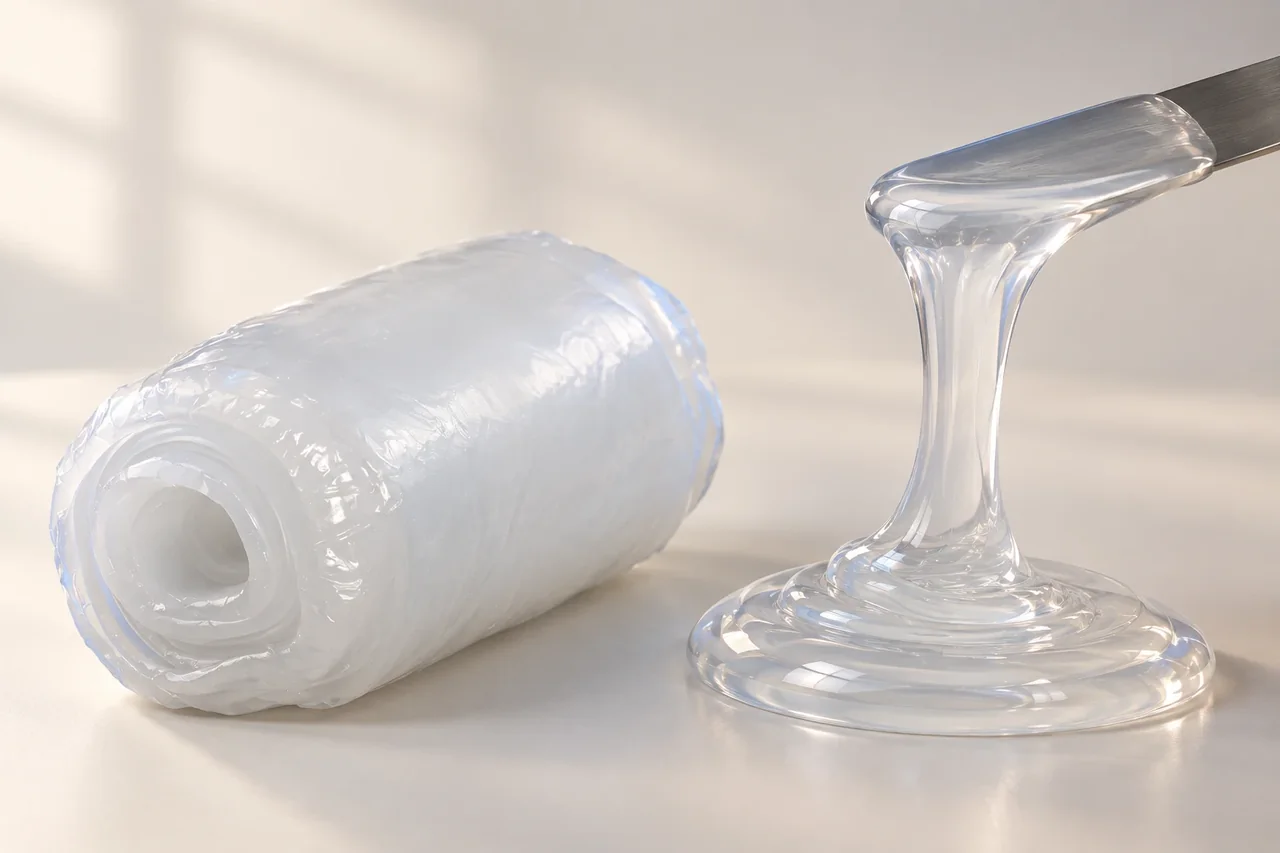
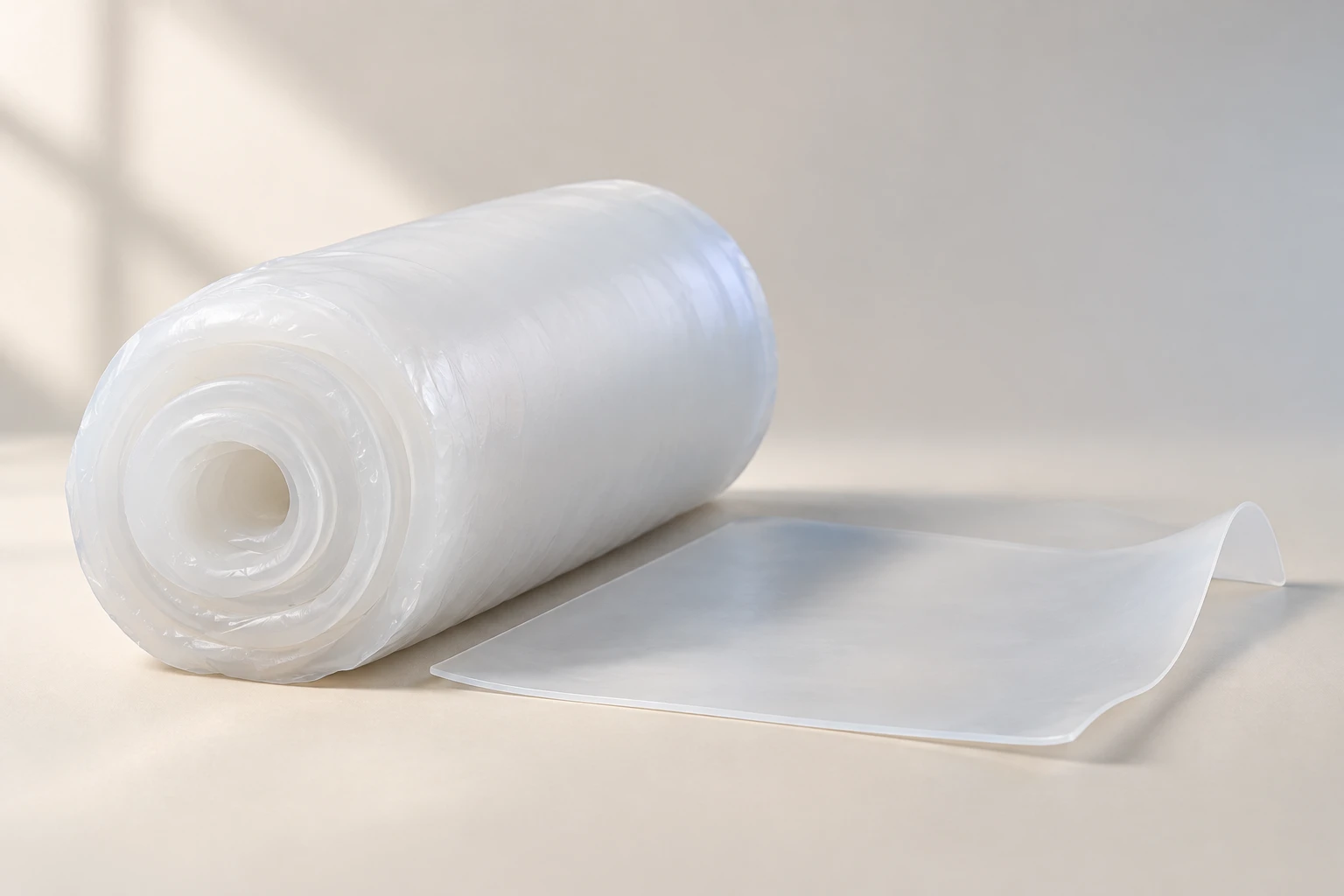
HIGH CONSISTENCY SILICONE RUBBER / HCR
Translucent, flexible solid compounds reinforced with fumed silica. The T series focuses on transparency, S on designated food and medical applications, and G on high tear resistance.
Transparent accessories · Seals and gaskets · Flexible sleeves and profiles
QX SERIES / TECHNICAL DATA
Grade code = series + nominal hardness + performance suffix.
| Grade | Hardness / Shore A | Density / g/cm³ | Tensile strength / MPa | Elongation at break / % | Tear strength / kN/m |
|---|---|---|---|---|---|
| QX20T | 20±2 | 1.20±0.02 | ≥8.5 | ≥400 | ≥18 |
| QX30T | 30±2 | 1.20±0.02 | ≥8.5 | ≥400 | ≥18 |
| QX40T | 40±2 | 1.20±0.02 | ≥8.5 | ≥400 | ≥18 |
| QX50S | 50±2 | 1.21±0.02 | ≥9.5 | ≥380 | ≥22 |
| QX60S | 60±2 | 1.21±0.02 | ≥9.5 | ≥380 | ≥22 |
| QX50G | 50±2 | 1.23±0.02 | ≥11.0 | ≥350 | ≥25 |
| QX60G | 60±2 | 1.23±0.02 | ≥11.0 | ≥350 | ≥25 |
| QX70G | 70±2 | 1.23±0.02 | ≥11.0 | ≥350 | ≥25 |
Values are from the product handbook. Hardness and mechanical properties refer to cured rubber; liquid viscosity is measured at 25°C. *S is a series designation, not certification for every application. Request grade-specific data and relevant compliance documents.
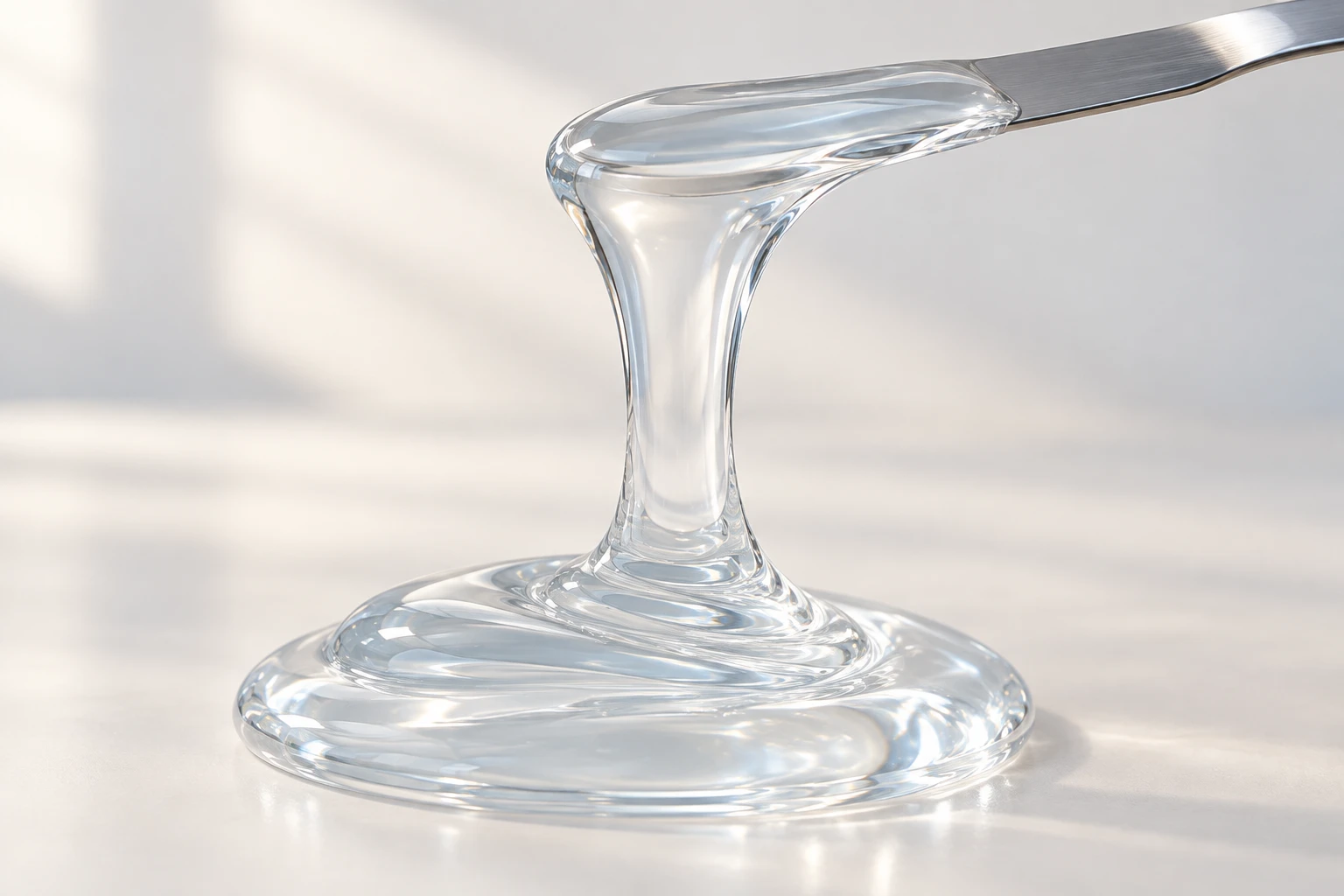
LIQUID SILICONE RUBBER / LSR
Clear, high-viscosity A/B compounds reinforced with fumed silica, with a platinum-catalysed cure system for liquid injection moulding.
Precision seals · Thin-wall moulded parts · Transparent functional components
LSR SERIES / TECHNICAL DATA
Grade code = series + nominal hardness + performance suffix.
| Grade | Hardness / Shore A | Density / g/cm³ | Viscosity / Pa·s at 25°C | Tensile strength / MPa | Elongation at break / % | Tear strength / kN/m |
|---|---|---|---|---|---|---|
| LSR20T | 20±3 | 1.10±0.02 | 150±20 | ≥7.5 | ≥600 | ≥20 |
| LSR30T | 30±3 | 1.10±0.02 | 150±20 | ≥7.5 | ≥600 | ≥20 |
| LSR40T | 40±3 | 1.10±0.02 | 150±20 | ≥7.5 | ≥600 | ≥20 |
| LSR50S | 50±3 | 1.12±0.02 | 160±20 | ≥9.0 | ≥550 | ≥28 |
| LSR60S | 60±3 | 1.12±0.02 | 160±20 | ≥9.0 | ≥550 | ≥28 |
| LSR50G | 50±3 | 1.14±0.02 | 180±20 | ≥10.5 | ≥450 | ≥35 |
| LSR60G | 60±3 | 1.14±0.02 | 180±20 | ≥10.5 | ≥450 | ≥35 |
| LSR70G | 70±3 | 1.14±0.02 | 180±20 | ≥10.5 | ≥450 | ≥35 |
Values are from the product handbook. Hardness and mechanical properties refer to cured rubber; liquid viscosity is measured at 25°C. *S is a series designation, not certification for every application. Request grade-specific data and relevant compliance documents.
CORE PERFORMANCE & PROCESSING
These are reference values from the product handbook. Confirm the grade, cure conditions and part geometry before setting production parameters.
| Parameter | Solid silicone rubber / QX | Liquid silicone rubber / LSR |
|---|---|---|
| Compression set · 180°C × 22 h | ≤28%; high-end grades ≤25% | ≤22%; high-tear precision grades ≤20% |
| Rebound resilience | ≥50%; high-tear grades ≥55% | ≥58%; high-tear grades ≥62% |
| Temperature range · handbook | −60 to 230°C | −60 to 250°C |
| Volume resistivity | ≥1.0 × 10¹⁵ Ω·cm | ≥1.2 × 10¹⁵ Ω·cm |
| Dielectric strength | ≥22 kV/mm | ≥25 kV/mm |
| Forming process | Compression moulding / extrusion | Dedicated liquid silicone injection moulding |
| Cure system | DBPH peroxide cure system | Platinum-catalysed, two-component A/B |
| A:B mixing ratio | Not applicable | 1:1 |
| Cure temperature | 170–180°C | 120–150°C |
| Cure time | 5–8 min | Confirm for the grade and part geometry |
| Moulding shrinkage | Not specified in handbook | 1.8–2.5% |
Handbook temperature ranges do not guarantee continuous service under every load or environment. Processing conditions and final properties depend on the grade and curing conditions.
Hardness: GB/T 531.1-2008 · Tensile strength / elongation: GB/T 528-2009 · Tear strength: GB/T 529-2008 · Compression set: GB/T 7759.1-2015 · Liquid viscosity: GB/T 2794-2013.
Test method editions follow the supplied handbook. Request the applicable test conditions and current grade documents for qualification.
APPLICATIONS
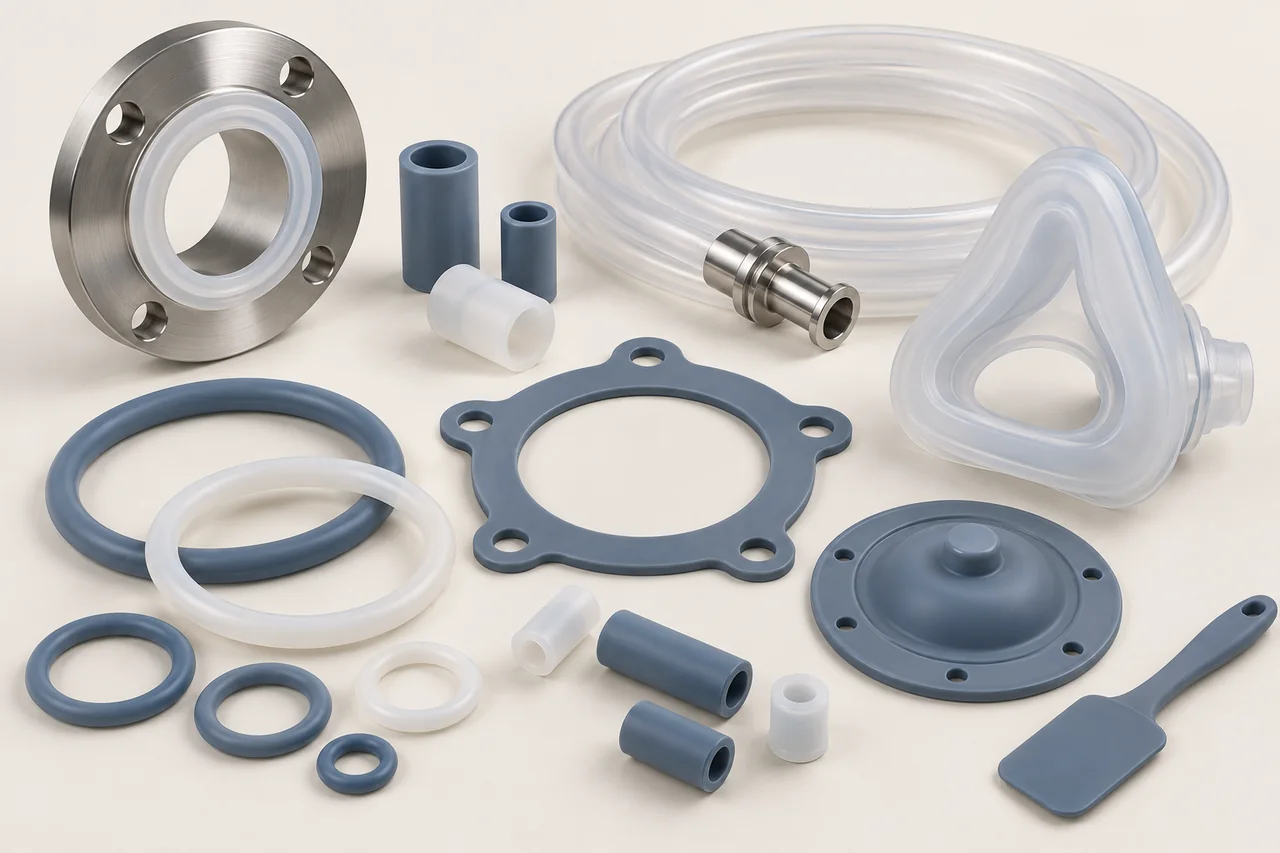
Equipment O-rings, flat gaskets and custom profiles selected for the operating environment.
Flexible tubing, connector seals and diaphragms for fluid-handling assemblies.
Mask cushions, soft interfaces and precision molded device parts.
Custom gaskets, insulating sleeves and protective boots matched to the assembly and operating conditions.
Options are also available for selected kitchen accessories and soft-touch consumer components.
These are application examples, not product certifications. Semiconductor use requires equipment-specific qualification. Plasma exposure and aggressive chemicals need separate material assessment. Medical, bioprocess and food-contact applications require suitable grades and validation for the intended use.
LET’S TALK MATERIALS
Tell us the application, forming process, target hardness and appearance you need.